
Richmond County Probate Court Overview
Richmond County Probate Court is the local court for probate matters at 735 James Brown Boulevard, Suite 1000, Augusta, GA 30901. Judge Stacy Y. Johnson is the present Probate Court Judge. The court lists public hours as 8:30 a.m. to 5:00 p.m. Monday through Friday, with a staff meeting on Mondays from 9:00 a.m. to 10:30 a.m. The court mission is to perform constitutional duties in a fair, professional, compassionate, and fiscally responsible way.
Probate scope in Richmond County includes will probate, administrations, no administration necessary, year's support, temporary and permanent minor guardianships, adult guardianships and conservatorships, conservatorships of minor property, VA fiduciary requirements, involuntary committals, living wills, marriage licenses, and concealed weapons permits. Probate Court staff may answer basic questions about standard forms, deadlines, scheduling, and procedures. State law bars staff from giving legal advice, restating the law, or recommending a specific way to pursue legal action.
The source image from the Richmond County Probate Court page shows the local court page for Richmond County probate records and services.
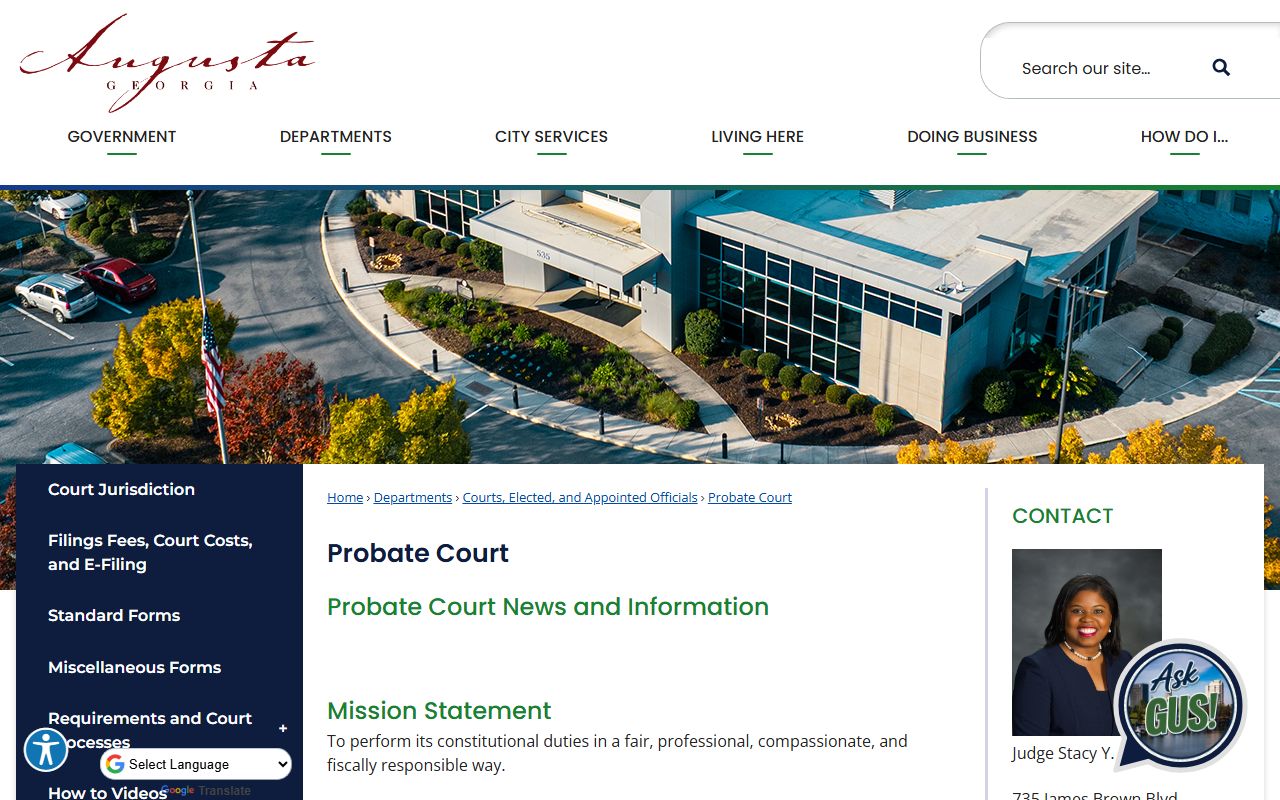
That local court page is the best starting point because Richmond County probate filings are not handled by the Superior Court clerk's case search alone.
Richmond County Probate Terms
Probate filings use terms that do not appear in ordinary civil cases. A short definition box helps separate estate authority from custody or property-control authority. These definitions are general reading aids; they do not replace advice from a Georgia attorney or an order from Richmond County Probate Court.
- Testator
- The person who made a will.
- Executor
- The person named to carry out a will after the court grants authority.
- Intestate
- Dying without a valid will, which changes the estate process.
- Guardianship
- Legal authority over a minor or incapacitated adult's person.
- Conservatorship
- Legal authority over another person's property or finances.
How to Search Richmond County Probate Court
Richmond County Probate Court has more than one access path. Estate and guardianship filings can be filed or managed through Probate Court, with optional e-filing through TrueFiling. Marriage licensing and recorded marriage search use Georgia Probate Records. Paper filings, certified copies, and questions about the correct proceeding still route to the Probate Court office. The court requires standard forms from the Council of Probate Court Judges or Georgia Supreme Court standard forms.
- Identify the proceeding first: estate, year's support, guardianship, conservatorship, marriage license, weapons permit, or another Probate Court matter.
- Use the official Probate Court page to locate forms, filing fee guidance, TrueFiling information, and marriage-license tools.
- For e-filing, create a TrueFiling account and follow Richmond County's probate e-filing rules.
- For non-digitized records or certified copies, contact Probate Court directly at the courthouse office.
- For a legal interpretation issue, contact a Georgia attorney because Probate Court staff and the judge cannot choose the proceeding for a filer.
The source image from the TrueFiling portal shows the e-filing channel Richmond County Probate Court accepts.

TrueFiling can start probate filings online, but original-will and original-bond rules still require physical document handling.
Richmond County Probate Contact Card
There is one county Probate Court identified in the Richmond County research. Suite numbers matter at the downtown courthouse because several court offices share the same building. Probate Court is Suite 1000, while the Clerk of Superior, State & Juvenile Court is Suite 1500 and Civil & Magistrate Court is Suite 1400.
Richmond County Probate Court
Judge: Stacy Y. Johnson
735 James Brown Boulevard, Suite 1000
Augusta, GA 30901
(706) 821-2434
Fax: (706) 821-2442
Monday-Friday, 8:30 a.m.-5:00 p.m.
Staff meeting Mondays, 9:00 a.m.-10:30 a.m.
Richmond County Probate Fees
Richmond County Probate Court states that Georgia Probate Court filing fees are set by O.C.G.A. § 15-9-60 and that Senate Bill 232 updated statutory fees effective January 1, 2025. The research did not capture a line-by-line statutory fee amount table for each petition type, so the safest fee schedule is the court's payment-rule table. Pleadings mailed without the proper filing fee are returned without filing, and fees or costs are not refunded if a filer chooses the wrong petition.
| Payment / Fee Rule | Richmond County Probate Court Detail |
|---|---|
| Statutory fees | Set by O.C.G.A. § 15-9-60; SB 232 updated statutory fees effective January 1, 2025. |
| Court costs | Local court costs are required before receiving an order. |
| Refunds | Fees and costs are not refunded if the filer chose the incorrect petition. |
| Personal checks | Probate Court is not currently accepting personal checks. |
| Mailed requests | Must be paid by money order, cashier's check, or law firm check. |
| Cards | Discover, MasterCard, and Visa accepted on premises by appointment; phone number and identifying information required. |
| Phone payments | No credit-card payments are accepted by telephone. |
| Estate notation | Put estate name and/or estate number on business checks, money orders, and cashier's checks. |
The source image from the Probate Court filings, fees, costs, and e-filing page shows the local fee and e-filing rules.
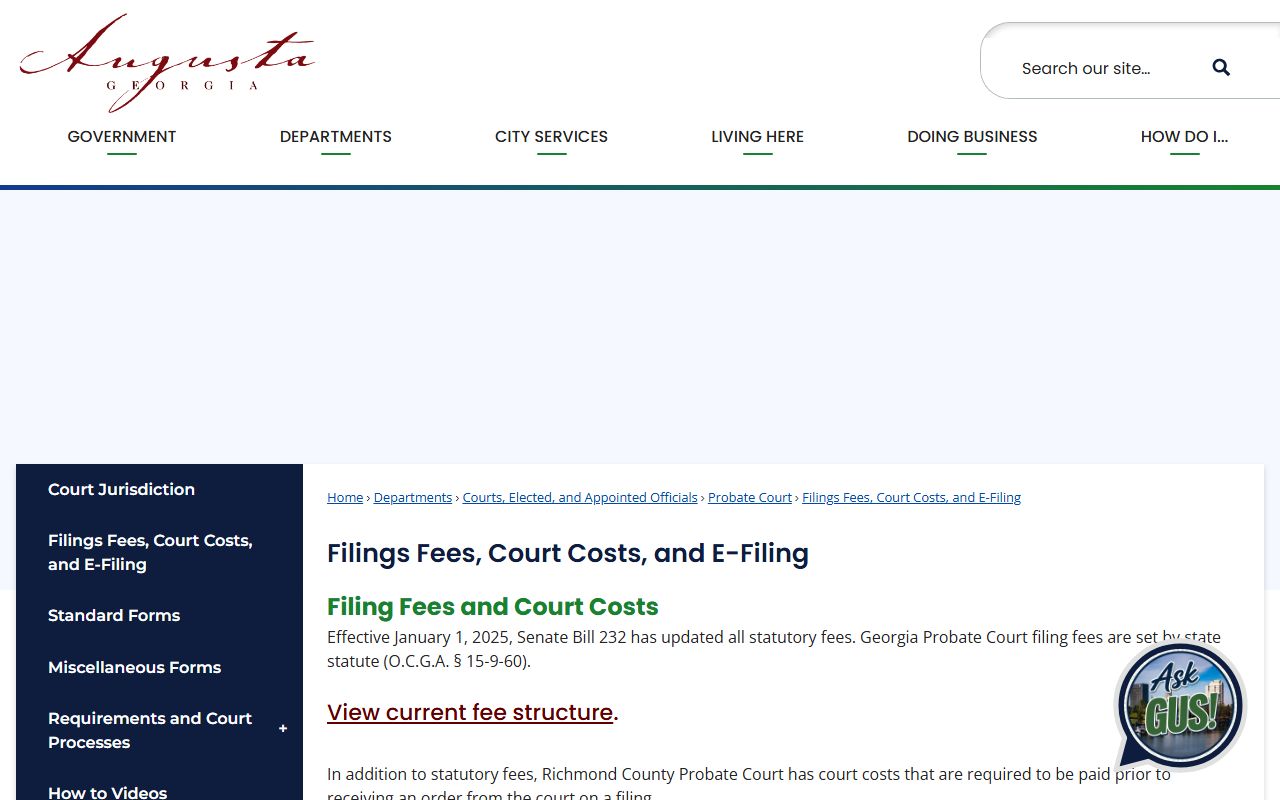
That page is important because Richmond County Probate Court ties fee payment, e-filing, and original document rules together.
What Richmond County Probate Records Show
Richmond County probate records can show the estate name, estate number, petition type, petitioner, respondent or interested parties, will filings, letters, inventories, accountings, guardianship petitions, conservatorship materials, background-check requirements, conservator questionnaires, affidavits of service, and required certificates. Estate filings may require death certificates. Minor guardianship filings may require birth certificates and, when applicable, death certificates. These records are not interchangeable with marriage records, divorce decrees, or criminal court files, even though several offices share the same courthouse.
Self-represented filers have several local duties before a Richmond County probate record is accepted. The Probate Court process page says a filer without an attorney must determine the appropriate proceeding, complete the forms properly, and use typed or legibly printed standard forms. Mail-filed pleadings must be signed, verified, and sent with the correct filing fees. Pleadings without the required fees are returned without filing. For adult and minor guardianship or conservatorship matters, background checks and conservator questionnaires may be required before the court can move the petition forward.
The source image from the Probate Court requirements and court processes page shows Richmond County's instructions for forms, deadlines, and filing duties.
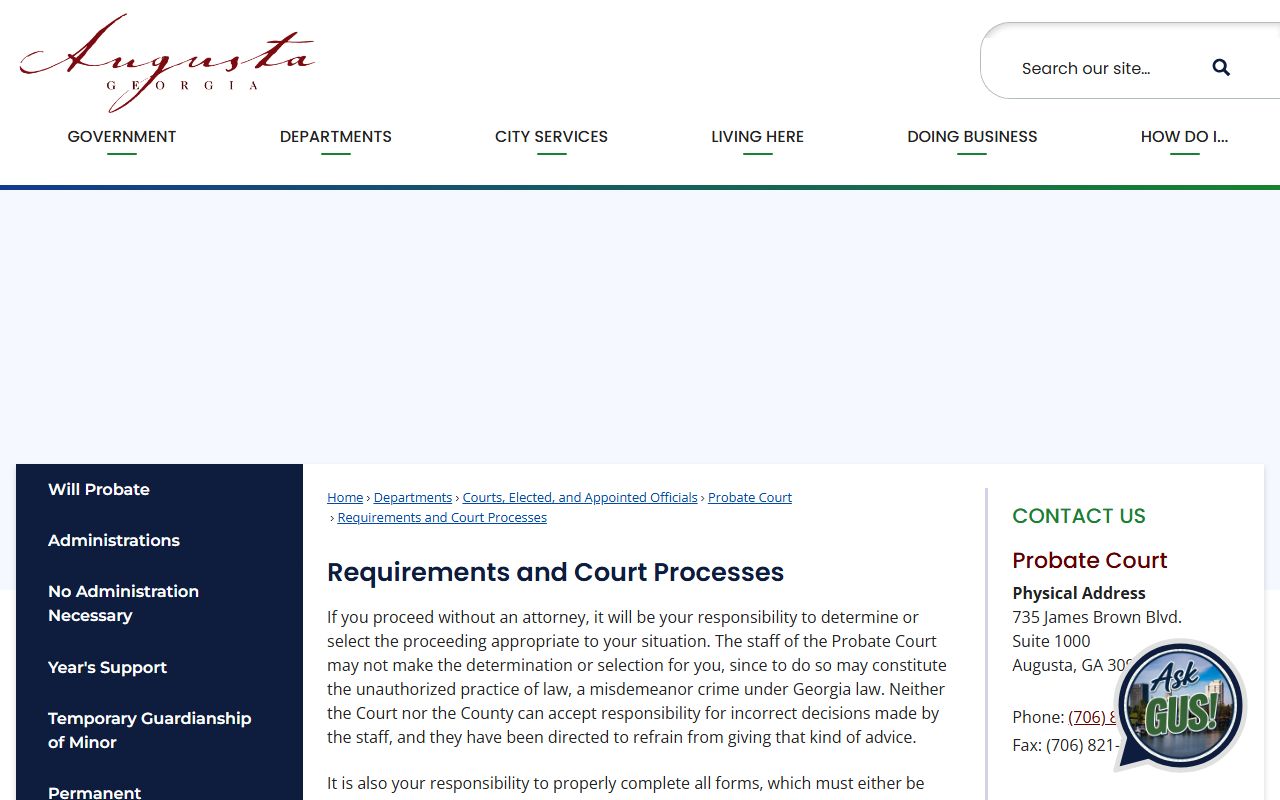
The process page is the key source for why self-represented filers must choose and complete the right probate proceeding themselves.
Original will rule: A copy of the Last Will and Testament may be uploaded through TrueFiling, but the original will must be filed with the court within ten days of electronic submission. Failure to file the original will results in dismissal of the petition.
Surety bonds have a similar original-document rule. Richmond County Probate Court permits an uploaded bond copy, but the original must be received and filed on time. Documents still need original wet signatures and initials where required; electronic signatures and /s/ signatures are rejected. Filers are told to retain originals for possible later proceedings and not to mail duplicate originals except when the original will or surety bond must be filed.
Restricted Richmond County Probate Records
Most ordinary probate court records are generally public under Georgia probate access rules unless a statute or order restricts access. Richmond County probate materials also include matters that can be sensitive, including adult guardianships, minor guardianships, conservatorships, involuntary committals, and documents with Social Security numbers or bank-account numbers. The Probate Court e-filing guidance specifically addresses sensitive information and says filers should upload documents containing sensitive information separately; the court clerk will redact if necessary upon receipt.
Uniform Probate Court Rule 4 generally supports public access to probate court records, while Georgia's Open Records Act supports public-records access more broadly. Those access rules do not make mental-health, minor, sealed, or redacted information public. For restricted records, parties should contact the court or counsel rather than expecting a public portal to display the full file.
Marriage licensing is the most common Probate Court record path that overlaps with vital-record searches, but it should not be confused with estate or guardianship filings. Richmond County uses Georgia Probate Records for marriage-license application and recorded marriage search, while estate and guardianship records still depend on the Probate Court filing process. A requester who needs an estate order, letters, or guardianship authority should use the Probate Court case route, not the marriage search tool.
Probate Court also handles concealed weapons permits and involuntary committals, but those topics do not create ordinary public estate records. Sensitive probate-related matters may require proof of party status, a court order, or attorney involvement before details can be released. When the public record is available, certified copies still come from the court office that maintains the file.
Note: Probate Court staff can answer basic process questions, but they cannot tell a filer which probate proceeding to choose.