
Search Richmond County Court Records
The first official route is Augusta's Case Management Search gateway for the Clerk of Superior, State & Juvenile Court. The gateway is not a bare search box. It starts with a disclaimer, requires the user to choose "Yes I Agree," and opens the case-management application in a new window. The research notes that Augusta does not certify the authenticity or accuracy of the online data and gives no warranties for use of the public portal.
That warning matters for Richmond County court records because online entries are useful for locating a file, checking a docket event, or finding a case number, but they are not the same thing as a certified copy. Certified records still come from the custodian. For Superior, State, and Juvenile Court case files, the custodian is the Clerk of Superior, State & Juvenile Court. For Civil and Magistrate matters, Probate Court matters, traffic payments, sheriff booking records, and warrants, the correct office may be different.
- Open the official Case Management Search gateway and read the disclaimer before entering the Richmond County court records application.
- Select "Yes I Agree" so the case-management application can open in a new browser window.
- Search with the case number when known, or use party details and the correct court type when the file number is not available.
- If the portal does not locate the case, identify the court first: Superior Court, State Court, Civil Court, Magistrate Court, Probate Court, or Juvenile Court.
- For a certified copy or a file not shown online, contact the office that maintains that record rather than relying on the search result.
The official source screenshot for this Richmond County court records portal shows the disclaimer screen that appears before the search application opens.
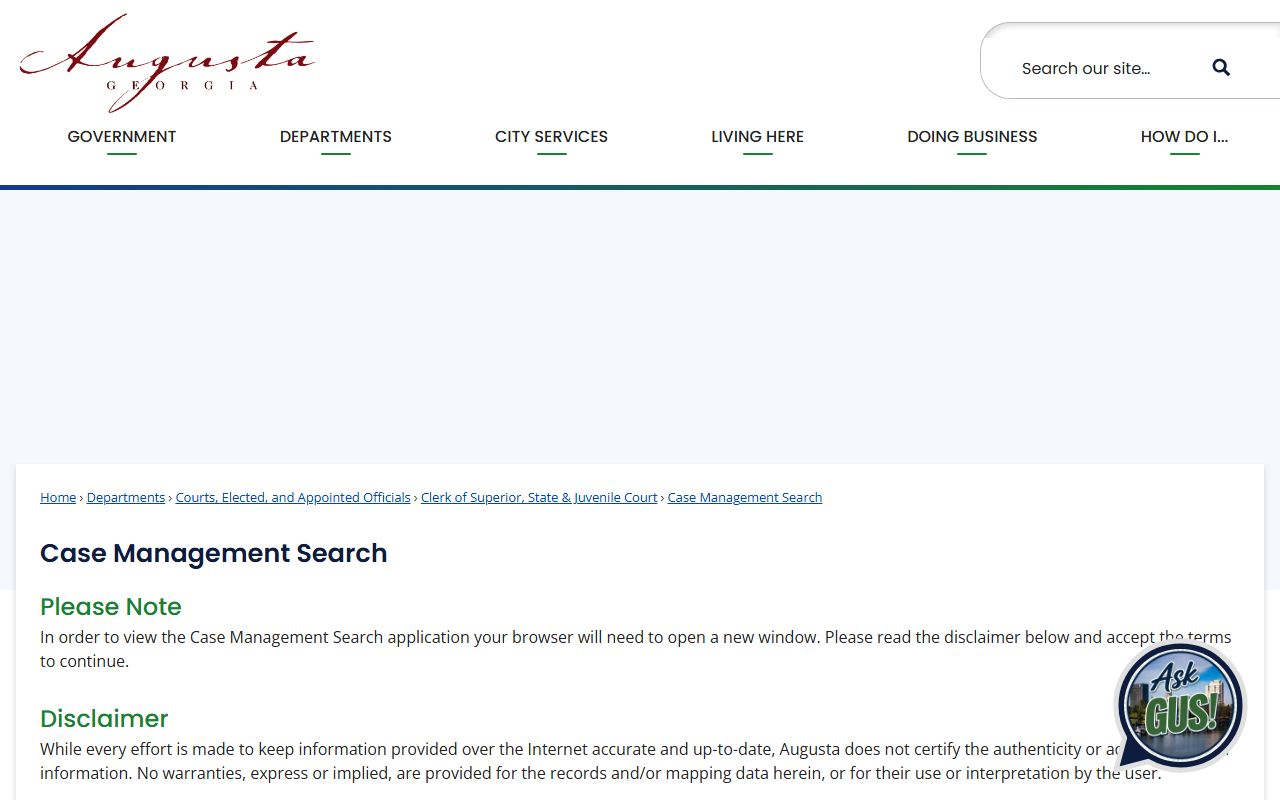
The image is useful because the disclaimer is part of the search process, not a side note. It is the county's first signal that portal data and certified court records serve different purposes.
Richmond County Court Records Fields
The research captured the public gateway fields rather than the full internal application fields, because static access did not expose every form control inside the search application. That still gives Richmond County court records users a clear entry sequence: the user must accept the disclaimer, allow the new window, and then search inside the clerk's application. The same practical rule applies to traffic and misdemeanor questions handled by the Solicitor: callers should gather identifying information before asking for case status.
| Field Label | Type | Required | Notes / Format |
|---|---|---|---|
| Yes I Agree | Link or button | Yes to enter | Opens the case management application in a new window. |
| No I Do Not Agree | Link or button | No | Returns the user to the Clerk of Superior, State & Juvenile Court page. |
| Disclaimer text | Notice | Yes to read | Explains no certification of accuracy, no warranties, and user acceptance. |
| Case number | Text | Recommended | Best identifier when calling or searching for a known file. |
| Defendant or party name | Text | Often needed | The Solicitor page asks for first and last name for criminal or traffic status. |
| Date of birth | Identifying detail | Optional if known | Helps separate people with similar names in Richmond County court records. |
For current misdemeanor and traffic case status, the Solicitor's court information page says the person should also have the charge description, offense date, case number, and the name of the court where the case is pending. Those details reduce the risk of confusing a State Court traffic matter with a Superior Court felony file or a Civil and Magistrate docket.
Types of Richmond County Court Records
Richmond County court records are split by court jurisdiction. Superior Court is the general jurisdiction court in the Augusta Judicial Circuit and handles felonies, divorce, equity, title-to-land disputes, habeas, mandamus, adoption, name changes, custody, and child-support enforcement. State Court handles misdemeanors, traffic violations, and civil actions unless a matter is reserved for Superior Court. Civil Court handles local civil disputes up to the amount identified in the research, and Magistrate Court handles lower-value civil claims, warrants, dispossessory matters, and garnishments.
Probate Court, Juvenile Court, and sheriff records should not be collapsed into one broad court-record label. Probate Court maintains estates, guardianships, conservatorships, marriage licenses, weapons permits, and related filings. Juvenile Court records are routed through the clerk for some purposes, but public access is restricted. Sheriff booking records and jail details are law-enforcement records, not clerk case files, even when they include charge text or bond fields.
- Civil court records include complaints, answers, motions, orders, judgments, writs, garnishments, and service returns.
- Criminal court records include accusations, indictments, bonds, arraignment entries, pleas, dispositions, sentencing, probation terms, and appeal notices.
- Family records include divorce, custody, child support, legitimation, contempt, modification, and adoption jurisdiction, though adoption records are restricted.
- Probate records include wills, administrations, guardianships, conservatorships, marriage licenses, and weapons carry matters.
- Traffic records include citations, court dates, pleas or payments, fines, dispositions, and required court appearances.
The official clerk about page describes the Richmond County clerk's constitutional role and the range of court records, real estate records, notary records, trade names, and military discharges tied to the office.
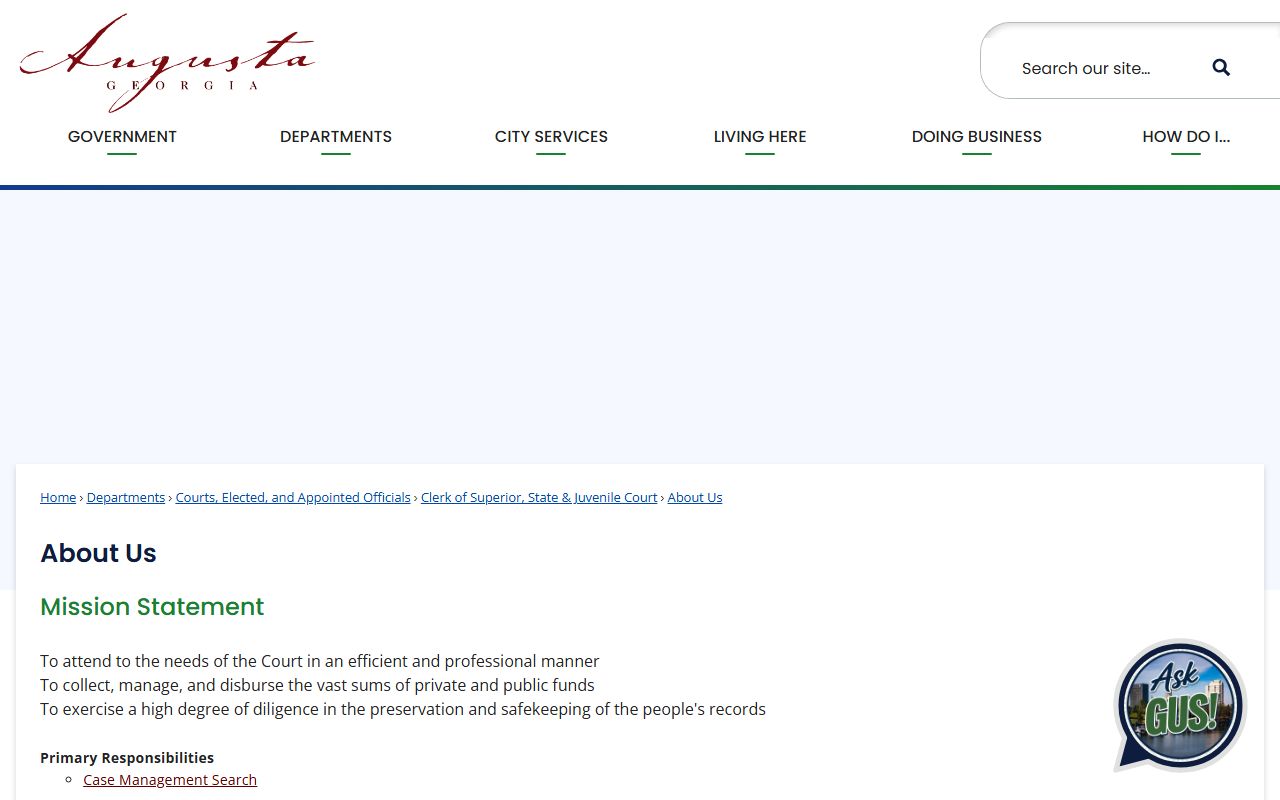
That office profile helps explain why many searches begin with the Clerk of Superior, State & Juvenile Court even when the case type later points to a more specific counter or division.
What Richmond County Court Records Show
A Richmond County court record can be a short docket result or a complete file with pleadings and orders. The fields vary by court. A civil file may use plaintiff and defendant labels. A criminal file may list the State and the defendant. Probate records may use petitioner, respondent, estate name, and estate number. Traffic matters may rely on citation number, case number, driver's license number, offense date, court date, and payment status.
| Field | What It Shows |
|---|---|
| Case number or civil action file number | The local file identifier used by the court, clerk, parties, and notices. |
| Court name | Whether the matter is in Superior, State, Civil, Magistrate, Probate, or Juvenile Court. |
| Parties | Plaintiff and defendant, State and defendant, petitioner and respondent, or estate-related names. |
| Filing, arrest, or citation date | The event date tied to the pleading, booking, charge, or traffic citation. |
| Docket entries | Motions, continuances, hearing notices, orders, judgments, pleas, warrants, and final dispositions. |
| Financial fields | Fines, court costs, bond amounts, filing fees, certified-copy charges, and warrant application fees. |
| Documents | Pleadings, petitions, accusations, indictments, divorce decrees, probate forms, orders, and certified copies. |
| Redactions | Limits on Social Security numbers, bank accounts, minor details, sealed charges, adoption records, and mental-health records. |
Public Access to Richmond County Court Records
Georgia law and court rules favor public access, but Richmond County court records are still controlled by the office that keeps each file. The Georgia Open Records Act supports public-records requests to agencies. Uniform Superior Court Rule 21 controls public access to Superior Court records unless a statute, rule, or order limits access. Uniform Probate Court Rule 4 does the same in the probate context.
The practical result is simple. A public record may be open, but it may not be online. A file may be searchable, but a certified copy may require a clerk request. A record may exist, but parts may be sealed, restricted, or redacted. For criminal history limits, Georgia uses the term "record restriction." The GBI resource for criminal history record restrictions cites O.C.G.A. § 35-3-37 and explains that some records may be hidden from the public without being destroyed.
Note: Online Richmond County court records help locate a case, but certified copies must come from the proper custodian.
Restricted Richmond County Court Records
Several Richmond County court records categories need extra care. Juvenile matters involving delinquent, unruly, or deprived children under 17 are not treated like adult case files. Adoption cases are within Superior Court authority, but adoption files are confidential under Georgia law. Probate Court handles involuntary committals and other sensitive matters, so mental-health records should not be described as ordinary public estate files. Probate e-filing guidance also flags Social Security numbers and bank-account numbers as sensitive information.
Restricted criminal records have a separate route. Georgia.gov, Georgia Courts, and GBI materials all route eligible users toward record restriction or expungement resources. For arrests after July 1, 2013, the research says the person must contact the prosecutor to have the record restricted. For arrests before that date, the person applies at the arresting agency. In Richmond County, felony questions may involve the District Attorney, while misdemeanor and traffic questions may involve the Solicitor General.
Richmond County Court Records Requests
In-person requests work best when the requester knows the case type, court, name, date, and file number. The Augusta-Richmond County Judicial Center and John H. Ruffin, Jr. Courthouse is a consolidated court campus, so the suite number matters. The clerk's suite is not the Probate Court suite, and Civil and Magistrate records are handled through a different office. Traffic payment mail uses the Traffic Violations Bureau address tied to the same downtown courthouse.
Clerk of Superior, State & Juvenile Court
735 James Brown Boulevard, Suite 1500
Augusta, GA 30901
(706) 821-2460
Monday-Friday, 8:30 a.m. to 5:00 p.m.
Civil & Magistrate Courts
735 James Brown Boulevard, Suite 1400
Augusta, GA 30901
(706) 821-2370
Monday-Friday, 8:30 a.m. to 5:00 p.m.
The GSCCCA Richmond County clerk directory identifies Hattie Holmes Sullivan as the Richmond County Superior Court clerk and lists the office location and hours.
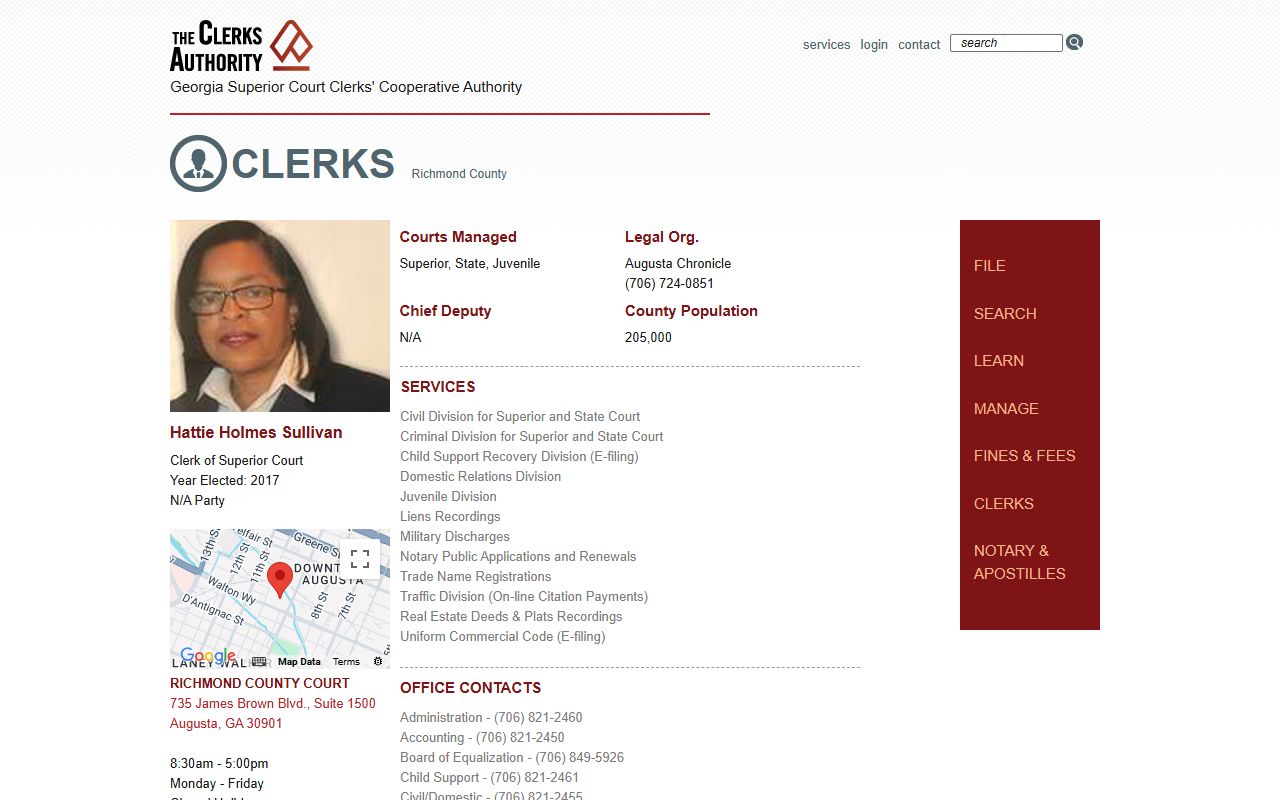
That directory gives a second official path for confirming the Richmond County clerk's role before requesting case records or certified copies.